
Common Exercise Excuses — and How to Beat Them
Every skipped workout starts with a story. Here's how to recognise your go-to excuse and actually move past it.

Editorially reviewed
Bassam Mallick · Last reviewed 28 October 2020
Master Nutrition Coach · MSc Kinesiology, Sports & Performance Nutrition · Lifestyle & Metabolic Medicine, Harvard Medical School
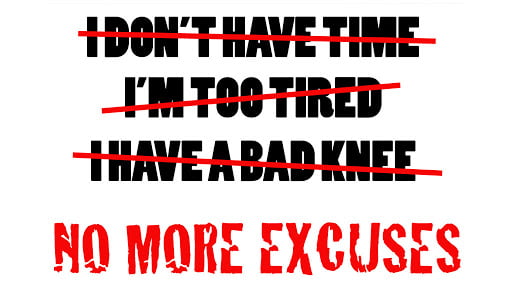
In years of coaching clients, I've heard every excuse a human can generate for skipping training. “Traffic was terrible.” “I'm getting a cold maybe.” “The kids had a tough day.” “Knee felt weird this morning.” “Just one rest day.” “Mondays don't work for me anymore.” The excuses themselves are infinitely creative. What's surprisingly un-creative is the timing — they almost always show up at the same predictable points in a fitness journey, and once you know the timing you can build around them in advance.
The clients who train consistently for years aren't more disciplined people. They're not better at “motivation.” They've simply learned which excuses their brain reaches for at which point in the week, the month or the year — and they've built tiny pre-commitments that bypass the negotiation. Knowing the patterns is the first move. Removing the negotiation point is the second. Here are the most common patterns I see and the fixes that actually work.
Starting a fitness routine is straightforward in theory and surprisingly slippery in practice. The moment life gets busy — or uncomfortable — your brain gets creative. Suddenly the gym is too far, the timing is wrong, or you simply "just don't feel like it." These are not character flaws; they're predictable patterns that almost every person who has ever tried to get fit has faced. The good news is that once you recognise your excuse for what it is, you have real options for working around it.
"I hate exercise"
This is probably the most honest excuse of the lot — and it's worth taking seriously. If every session feels like punishment, you've chosen the wrong activity, not the wrong lifestyle. Exercise is not a fixed menu of burpees and treadmill slogs. It includes dancing, swimming, badminton, hiking, martial arts, cycling, yoga, and dozens of other movement forms. The only rule is that your body has to move with some degree of consistent effort.
Spend a few weeks experimenting. Try a sport you enjoyed as a teenager. Join a group class that has a social element. Walk briskly through a neighbourhood you find interesting. When the activity itself is even mildly enjoyable, consistency stops being a willpower battle.
"I've lost all motivation"
Motivation is a feeling, not a reliable fuel source. It spikes when you start something new and fades the moment routine sets in — usually around weeks three to six. This is not failure; it's neuroscience. The fix is to build systems that don't depend on feeling inspired.
Motivation gets you started. Habit — built through small, consistent actions — keeps you going when motivation disappears.
A few strategies that actually work:
- Rotate your programme every four to six weeks. Small changes — a new exercise, a different rep range, a slightly heavier load — are enough to keep your sessions feeling fresh without rebuilding everything from scratch.
- Track your progress concretely. Write down your weights, your times, or your distances. Watching numbers move — even slowly — is a powerful motivator that feelings alone can't replicate.
- Build in small rewards. A good meal, a film, an unscheduled rest day after hitting a two-week streak — pairing effort with a reward reinforces the habit loop at a neurological level.
- Reconnect with your "why." Stick a short note on your phone or mirror reminding you what you're training for — better energy, reduced back pain, a 5 km run. Specificity matters more than inspiration.
"I can't afford a gym membership"
A gym is a tool, not a prerequisite. Bodyweight training — push-ups, squats, lunges, planks, and their many progressions — can build genuine strength and fitness with zero equipment. A clear patch of floor in your home is enough to start.
If you want more structure, resistance bands cost a few hundred rupees and add meaningful load to any bodyweight routine. A single pair of adjustable dumbbells expands your options further. None of this requires a monthly membership or a commute. Many high-quality workout programmes are available free on YouTube; others are available as affordable apps. The barrier to entry for home training has never been lower.
"I don't have time"
This one deserves honesty rather than dismissal. Life genuinely gets crowded. But research consistently shows that even 20–30 minutes of moderate-intensity exercise three to four times per week produces meaningful health and fitness benefits. You don't need to find an hour; you need to protect 25 minutes.
Audit one week of your schedule before concluding you have no time. Look at commute patterns, lunch breaks, and the first or last 30 minutes of your day. Most people discover at least one usable window — they just haven't decided to use it yet.
"I'm too tired"
Fatigue is real, and sometimes rest is genuinely the right choice. But chronic tiredness from a sedentary lifestyle is usually made worse, not better, by more sitting. Regular moderate exercise improves sleep quality, reduces stress hormones, and raises baseline energy over time. On days when you feel low, commit to just ten minutes. More often than not, you'll finish the session — and feel better for it. On the rare day you truly don't, ten minutes of movement is still far better than nothing.
Key takeaways
- If you hate your current form of exercise, change the activity — not your commitment to being active.
- Don't rely on motivation alone; build a schedule, track progress, and reward consistency.
- A gym is optional. Effective training is entirely possible at home with minimal or no equipment.
- You need far less time than you think — 20 to 30 focused minutes, three to four times a week, is a solid starting point.
- Low energy is usually a reason to move gently, not a reason to skip — regular exercise improves energy over time.
Every excuse has a counter-move. The goal isn't to silence your inner voice of resistance forever — it's to know your playbook well enough that the excuses stop winning. Pick one obstacle from above, choose one practical fix, and act on it this week. That's how habits are built: one unglamorous decision at a time.
Get the weekly note.
Evidence-based nutrition + training, India-context, no fluff. One email a week from Bassam. Unsubscribe anytime.
Keep reading
Strength training for women over 35: the complete beginner's roadmap (India edition)
An evidence-based strength training roadmap for Indian women over 35: what your body is doing, how to start at home or in a gym, and the first 12 weeks. Built for Indian life.
Read
How to Choose Home Gym Equipment That You'll Actually Use
With hundreds of options on the market, buying the wrong equipment is an expensive mistake. Here's how to choose gear that fits your goals, space, and budget.
Read- 🩸
Iron-rich Indian foods for women: the complete anaemia-management guide
Iron-deficiency anaemia affects most Indian women. The honest food-first guide — the real iron content of Indian foods, the vitamin C trick that doubles absorption, the tea-timing that halves it, and how to rebuild ferritin, not just haemoglobin.
Read