
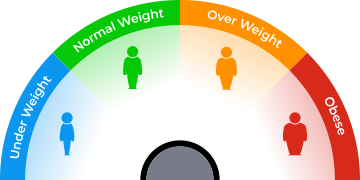
What is BMI?
Body Mass Index is a ratio of weight to height — kilograms divided by metres squared. The World Health Organization uses it as a quick screening number for whether an adult's weight sits in a healthy range. It's simple, free, and works the same way everywhere — which is exactly why it caught on. It is nota diagnosis: BMI can't tell muscle from fat and it doesn't say where fat is stored. Treat your number as a starting point, not a verdict.
How to use this calculator
- 1Choose metric (kg / cm) or imperial (lb / ft–in).
- 2Drag the sliders to your weight and height.
- 3Pick a reference standard — Asia-Pacific uses lower thresholds and is more appropriate for South-Asian bodies.
- 4Read your BMI, the band you sit in, and the healthy weight range for your height.
The BMI formula and what the bands mean
BMI uses the same formula regardless of units: weight in kilograms ÷ height in metres squared (kg/m²). For imperial units it's pounds ÷ inches² × 703. A 70 kg adult who is 1.75 m tall has a BMI of 70 ÷ (1.75 × 1.75) = 22.9.
| BMI | Category | What it means |
|---|---|---|
| < 18.5 | Underweight | May indicate undereating or an underlying condition — worth checking with a clinician. |
| 18.5 – 24.9 | Healthy weight | Lowest statistical risk of weight-related chronic disease for most adults. |
| 25.0 – 29.9 | Overweight | Modestly increased risk of hypertension, type 2 diabetes and cardiovascular disease. |
| 30.0 – 34.9 | Obesity class I | Notable risk increase; lifestyle changes typically recommended. |
| 35.0 – 39.9 | Obesity class II | High risk; medical guidance is usually advised. |
| ≥ 40.0 | Obesity class III | Very high risk; medical intervention is commonly indicated. |
The Asia-Pacific standard (used on this page by default) lowers overweight to 23 and obesity to 25, because South-Asian and East-Asian bodies develop cardiometabolic risk at a lower BMI.
When BMI gives a misleading answer
BMI was designed in the 1830s as a population statistic, not an individual diagnostic tool. It ignores body composition, so three groups routinely get a misleading reading:
- Muscular athletes — a rugby player or competitive lifter can read overweight or obese on BMI while carrying 10% body fat. The weight is muscle, not adipose tissue.
- Older adults — BMI can under-estimate body fat as lean muscle declines with age. A “normal” BMI at 70 may hide sarcopenic obesity.
- South-Asian and East-Asian populations — health risk rises at lower BMIs, which is why the WHO Asia-Pacific thresholds sit at 23 (overweight) and 25 (obesity).
Waist circumference, waist-to-height ratio and a body-fat estimate are better individual measures. Use BMI as a first-pass screen, not the final word.
BMI for children and pregnant women
The adult bands above do notapply to children, teenagers under 20, or pregnant women. Children use age- and sex-specific BMI percentiles from CDC or WHO growth charts — the same BMI number means different things at different ages. During pregnancy, weight gain is expected and BMI stops being meaningful; obstetric guidance uses pre-pregnancy BMI plus expected gestational weight gain. If either situation applies, this tool isn't the right one — ask a paediatrician or obstetrician.