
Strength training for women over 35: the complete beginner's roadmap (India edition)
An evidence-based strength training roadmap for Indian women over 35: what your body is doing, how to start at home or in a gym, and the first 12 weeks. Built for Indian life.
Editorially reviewed
Bassam Mallick · Last reviewed 24 May 2026
Master Nutrition Coach · MSc Kinesiology, Sports & Performance Nutrition · Lifestyle & Metabolic Medicine, Harvard Medical School
Somewhere between 35 and 45, most women I coach describe the same quiet shift. The scale stops responding to the same effort. Energy dips by mid-afternoon. Sleep gets lighter — you wake at 3 am and lie there. Clothes start to fit differently around the middle long before any number on the scale moves.
I have coached women who started lifting weights at 38, at 45, at 52. Working mothers, perimenopausal women, women who had never been inside a gym. The single most powerful, most underused response to that 35-and-beyond shift is strength training. Not yoga alone. Not walking alone. Not cardio. Loading your bones and muscles against resistance, two or three times a week, for the rest of your life.
This is the honest version of why, and how to start. Written for Indian women — for the realities of family expectations, gym anxiety, modesty considerations, working days that don't leave a spare hour. It is not personalised medical advice. If you have a diagnosed condition, recent surgery or uncontrolled blood pressure, clear this with your doctor first.
What your body is actually doing in your late 30s and 40s
There is no cliff. Your body doesn't fall off a metabolic edge on your 40th birthday. What does happen, quietly, is a set of gradual processes that began earlier than most women realise.
Muscle mass declines. This is called sarcopenia, and it begins surprisingly early — often in your early 30s — for women who don't load their muscles with resistance. Roughly 3 to 8 percent per decade, accelerating after menopause. Less muscle means slower metabolism, weaker posture, more risk of falls in your 60s and 70s, and less tissue to absorb blood sugar.
Bone density peaks in your late 20s to early 30s and declines after. The decline accelerates at menopause as oestrogen drops. By your 70s, this is the difference between a fall that bruises you and a fall that breaks a hip. The best non-medical intervention is loading the skeleton.
Oestrogen begins to fluctuate. Perimenopause is not a sudden event; it's a gradual recalibration that can begin in your late 30s and continue for a decade. Irregular cycles, interrupted sleep, mood swings, hot flushes, joint aches, weight gain around the middle. Normal physiology, not a disease. Hormone therapy is a conversation for your gynaecologist.
Insulin sensitivity drops. Cells become less responsive to insulin, especially around perimenopause. The same plate of food that was fine at 28 starts producing a softer middle at 42. Muscle is the biggest glucose sink in your body, which is why strength training is so useful here. Full mechanism in the insulin resistance piece.
Metabolism doesn't "crash." That is a media myth. Metabolic rate stays relatively stable from your 20s through your 50s. What changes is body composition — less muscle, more fat — and that changes how your body uses food.
Strength training addresses every one of these directly.
Why strength training is the most powerful intervention available to a woman over 35
If a pharmaceutical company invented a single pill that did what resistance training does, it would be the biggest drug launch of the decade.
It is the most evidence-backed intervention for bone density — the LIFTMOR trial found that even high-intensity resistance and impact training improved bone mineral density and physical function in postmenopausal women with low bone mass, safely (Watson et al., J Bone Miner Res, 2018). Fracture-resistant bones into your 60s, 70s and 80s. It is also the most evidence-backed for muscle retention, the biggest predictor of how independent you will be in old age. It improves insulin sensitivity, which translates to less stubborn belly fat and steadier energy. It corrects posture by strengthening muscles that have spent twenty years collapsing under laptops and children. It reduces back pain, often dramatically. And there is a growing body of research on what it does for mood, anxiety and sleep through perimenopause — the effect is real.
And one benefit that doesn't show up in any study but matters in real life: the calm capability of lifting a suitcase overhead, carrying your child up two flights of stairs, opening a jar, getting up from the floor without using your hands. That is the difference between an active life into your 70s and a slowly shrinking one.
The myths I'd like to bury
Three myths come up every week, in every consultation with a new woman over 35. All wrong, and they have cost a generation of Indian women a decade of strength.
"I'll get bulky." No. Building visibly large muscle requires a deliberate calorie surplus, years of dedicated heavy training, and levels of testosterone women's bodies simply do not produce. Female bodybuilders work for a decade, often with pharmaceutical help. A woman lifting three times a week builds a body that looks upright and capable. The outcome you fear is biologically extremely difficult to produce, even on purpose.
"Lifting at my age is risky." Far less risky than not lifting. Strength training with reasonable form carries low risk — minor strains that heal. The risk of going through your 50s, 60s and 70s with no resistance training is a body that loses muscle and bone steadily, until a small fall becomes a fractured hip. The genuine risk is bad form, not the activity.
"Yoga is enough." Yoga is wonderful. It does extraordinary things for mobility, balance, breathwork and the nervous system, and many of the women I coach do yoga alongside lifting and love it. But yoga does not load your bones and muscles the way strength training does. The two are complements, not substitutes. If you are over 35, prioritise strength and keep the yoga.
The honest worry — joints, surgery history, blood pressure
If you have arthritis, a knee or shoulder you've been managing, a back that flares, slipped discs, recent abdominal surgery, uncontrolled blood pressure, or any chronic condition under medical management, please clear strength training with your doctor first. Most of the time the answer is yes, with sensible adjustments. Sometimes the answer is yes, but begin with a physiotherapist. Occasionally the answer is wait. This is general adult guidance, not a treatment plan written for your body.
For everyone else: well-programmed strength training, started light, is one of the safest forms of exercise available to a healthy adult. The body that lifts becomes more durable, not less.
Where to start — three honest options
There is no single right answer. The right answer is the one you will actually do, three times a week, for years.
Home with a small set of dumbbells. For most working women in India — especially mothers, especially those for whom gym culture still feels alien — this is the most realistic entry point. A pair of adjustable dumbbells, a yoga mat, a sturdy chair, 45 minutes in a corner of your bedroom. Modesty-comfortable. Fits around children, family, work. Removes the gym-anxiety question entirely. The Beginner Home Workout Pack is the manual for this woman. The trade-off is that progression eventually plateaus — at some point you will need heavier weights than a home setup allows.
A women-friendly gym. Some Indian gyms are now genuinely welcoming to women over 35 — women-only hours, female trainers, an actual culture of seriousness. Many are not. Visit at the time you would actually train. If you walk in at 6 am on a Tuesday and see other women lifting, that's your gym. The advantage is access to barbells, racks and heavier weights, which matter once you outgrow dumbbells.
A personal trainer for the first 4 to 6 sessions. If you can afford it, this is the highest-leverage spend in your training life. Four to six sessions to learn the five basic movement patterns with a coach watching your form. A good female trainer who has trained women in their 40s is worth twice the price of a generic gym coach.
The one that works for your life is the right one.
The first 12 weeks — a real structure
Strip away the noise. Three full-body sessions a week, on non-consecutive days. About 45 minutes each. Five movement patterns rotated across the sessions:
| Pattern | Beginner exercise | Trains |
|---|---|---|
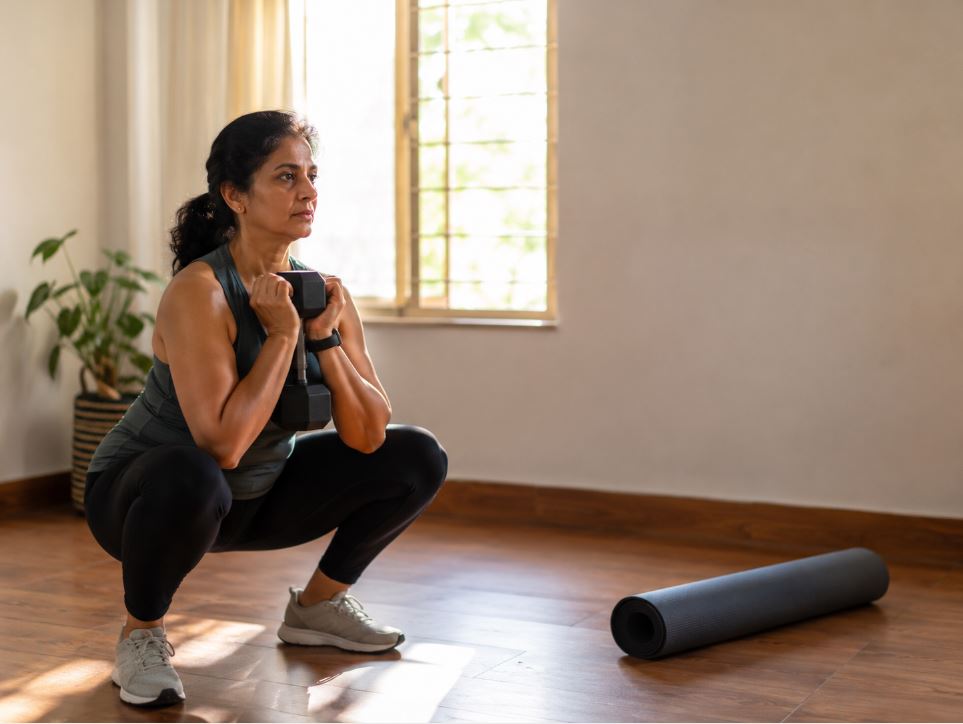
| Squat | Goblet squat (dumbbell at chest) | Legs, glutes |
| Hinge | Dumbbell Romanian deadlift | Hamstrings, glutes, back — fixes back pain |
| Push | Floor / bench dumbbell press | Chest, shoulders, triceps |
| Pull | Supported dumbbell row | Back, biceps, posture |
| Core | Plank, dead bug, suitcase carry | Trunk stability |
Squat — sitting down and standing up against load. Goblet squats holding a dumbbell at your chest are where everyone starts.
Hinge — bending at the hips, not the back. Romanian deadlifts with dumbbells. This single movement fixes more back pain than any other.
Push — dumbbell presses lying on the floor or a bench; later, a shoulder press.
Pull — dumbbell rows, supported on a chair or bench. Later, assisted pull-ups.
Core — planks, dead bugs, suitcase carries.
Three or four exercises per session, two to three sets of 8 to 12 reps each. Start light enough that the last two reps of your last set are the only hard ones. If you finish a set without breathing harder, the weight is too light. If you can't keep good form for all the reps, the weight is too heavy.
Progression is boring on purpose. Each week, add one more rep, or — when you can comfortably do the top of the rep range — a small increase in weight. Two and a half kilos. Sometimes one. The principle is called progressive overload, and it is the only thing your muscles respond to. You do not need new exercises every week. You need the same exercises, performed slightly harder, week after week, for years.
A realistic sample week
Monday, Wednesday and Friday, strength training, 45 minutes. Daily walks of 30 to 45 minutes at whatever time fits. Saturday, a longer recreational activity — a hike, a yoga class you enjoy, swimming if you have access. Sunday, complete rest. That's it. Realistic for a working mother, a homemaker with in-laws to feed, a woman running her own business.
What to eat alongside it
Strength training without enough food is the quietest mistake I see in women over 35. Decades of being told to eat less leave deep grooves. When you start training, you need materials.
Protein at every meal. Aim for 1.4 to 2.0 grams of protein per kilogram of body weight per day — and it matters more with age, because older muscle is more resistant to protein's muscle-building signal, so expert consensus pushes older adults' targets up, not down (Bauer et al., PROT-AGE, JAMDA, 2013). For a 60 kg woman, that is 84 to 120 grams daily, spread across three or four meals. A palm of paneer at breakfast, dal-plus-curd with lunch, eggs as a snack, chicken or fish or soy chunks at dinner. Vegetarian readers — see the vegetarian protein complete guide.
Enough food in total. Under-eating is the number one quiet mistake. If you are constantly hungry, sleep is bad, periods get irregular, and lifts stop progressing, you are eating too little. Strength training is a construction project. It needs bricks.
The same plate shape that already works. A palm of protein, one or two fists of vegetables, a measured portion of slow carb — rice, roti, millets — a thumb of healthy fat. Three times a day. The Indian Macro Cookbook is the cross-reference for meals built this way.
Period and perimenopause notes
Train as normal whenever you feel up to it. There is no good evidence that women should systematically alter their training around their cycle — most popular "cycle syncing" programs are entertainment, not science. On the first day or two of a heavy or painful period, train lighter, or skip a session. The rest of the cycle, train normally.
Perimenopausal fluctuations are normal and do not require special programming. Listen to your body. If you are exhausted, do a lighter session rather than skipping entirely. Hormone therapy or medication is a conversation for your doctor. Women who keep lifting through perimenopause report, almost universally, that strength training was one of the few things that consistently made them feel better.
The mistakes I see women over 35 make
Going too light forever. The weight has to be hard. If you do three sets of 10 with the same five-kilo dumbbells for six months and they still feel comfortable in the last rep, you are not strength-training; you are doing aerobic exercise with dumbbells in your hands. Pick up the heavier weight.
Cardio everything. An hour on the treadmill every day, year after year, is the default for many Indian women over 35. It burns calories in the moment but does very little for muscle, bone, posture or metabolic resilience. Replace at least two sessions a week with strength training.
Skipping strength for yoga only. As above — yoga is wonderful, but it does not load you. Both, not one.
Eating too little to support training. Especially among women who have spent two decades chronically dieting. New muscle costs food. Hunger is a signal, not a moral failing.
Quitting after four weeks because the scale didn't move. In your first three months of lifting, the scale is almost always the wrong measure. Clothes shift. Lifts move. The mirror changes. The scale often sits still — sometimes even rises a little, because you are building muscle while losing fat. Trust the lifts and the clothes for the first six months.
The realistic timeline
Within 2 to 4 weeks, your lifts start going up — your nervous system learning to recruit muscle fibres more efficiently, before any real muscle growth. You feel stronger. Daily tasks get easier.
Within 8 to 12 weeks, visible body composition changes show up. Posture improves. The soft middle starts firming. Clothes fit differently. You notice shape in shoulders and arms that wasn't there.
Within 6 months, meaningful change. People who haven't seen you in a while comment without you fishing for it.
After 12 to 24 months, you are a fundamentally different person — not bulky, but visibly strong, upright, capable. The women I have coached who kept going for years look meaningfully different from those who stopped. That is the entire game. Long, slow, durable compounding.
Where to start, in order
If you've read this far, here is what I would do.
Begin with The Strong Woman's First Program. The manual I have written for exactly this reader — a complete twelve-week plan you can do at home with dumbbells, with form cues, progression rules and a sample week built in. You can read Chapter 1 free before deciding.
If PCOS or insulin resistance is part of your story — irregular cycles, stubborn belly fat, sugar cravings — The PCOS & Insulin-Resistance Plan is the companion manual built for that overlap.
If you are ready to walk into a gym, The Beginner Gym Confidence Pack will save you the awkward first month of guessing.
If you want a personalised training week before buying anything, the free workout plan builder is a fine entry point.
If a pharmaceutical company invented a pill that did what strength training does for a woman over 35 — bone, muscle, insulin sensitivity, posture, mood — it would be the biggest drug launch of the decade.
You do not need to be brave. You do not need to be young. You do not need a fancy gym. You need three sessions a week, enough protein, enough sleep, and the patience to keep showing up while the body quietly rebuilds itself underneath you. Every woman I have coached who started at 38, 45 or 52 tells me, eventually, that she wishes she had started ten years earlier. The best time was a decade ago. The second-best time is this week.
Frequently asked questions
Will lifting weights make a woman over 35 look bulky?
No. Building visibly large muscle requires a deliberate calorie surplus, years of dedicated heavy training, and testosterone levels that women's bodies simply don't produce — female bodybuilders work for a decade, often with pharmaceutical help, to look that way. A woman lifting three times a week builds a body that looks upright, lean and capable, not bulky. The outcome you fear is biologically very hard to produce even on purpose; what you'll actually get is better posture, shape in your shoulders and arms, and a firmer middle.
Is it safe to start strength training in your 40s or 50s?
For most healthy adults, yes — and it's far riskier not to. Well-programmed strength training started light is one of the safest forms of exercise there is, and even high-intensity resistance training has been shown to safely improve bone density in postmenopausal women (the LIFTMOR trial). The real danger is going through your 50s, 60s and 70s losing muscle and bone until a small fall breaks a hip. If you have arthritis, a managed joint, uncontrolled blood pressure, recent surgery or any chronic condition, clear it with your doctor first — the answer is usually yes, with sensible adjustments.
Is yoga or walking enough, or do I need to lift weights?
Yoga and walking are genuinely valuable — for mobility, balance, breathwork, cardiovascular health and stress — but neither loads your bones and muscles the way strength training does, so neither drives the bone-density and muscle-retention adaptations that matter most after 35. They're complements, not substitutes. The strongest setup is three strength sessions a week as the priority, daily walking as the base, and yoga kept for what it's brilliant at. Prioritise the lifting; keep the rest.
How much protein should a woman over 35 eat when strength training?
Aim for 1.4–2.0 g of protein per kg of body weight per day — for a 60 kg woman that's about 84–120 g, spread across three or four meals. This matters more with age, not less: older muscle is more resistant to protein's building signal, so expert consensus actually raises the target for older adults. Practically, put a palm-sized protein at each meal (paneer, eggs, dal-plus-curd, soya, chicken, fish). Under-eating — a deep habit after decades of dieting advice — is the quiet mistake that stalls training, sleep and even periods.
How long until I see results from strength training?
Your lifts start climbing within 2–4 weeks (your nervous system learning to recruit muscle, before real growth), and daily tasks feel easier. Visible body-composition change — better posture, a firmer middle, shape in the shoulders — usually shows by 8–12 weeks, and by six months people comment without you fishing. Crucially, judge progress by your lifts, your clothes and the mirror, not the scale, for the first six months: the scale often sits still or even rises slightly because you're building muscle while losing fat.
References
- [1]
Watson SL, Weeks BK, Weis LJ, Harding AT, Horan SA, Beck BR (2018). High-intensity resistance and impact training improves bone mineral density and physical function in postmenopausal women with osteopenia and osteoporosis: the LIFTMOR randomized controlled trial. Journal of Bone and Mineral Research, 33(2):211-220.
View source - [2]
Bauer J, Biolo G, Cederholm T, et al. (PROT-AGE Study Group) (2013). Evidence-based recommendations for optimal dietary protein intake in older people: a position paper from the PROT-AGE Study Group. Journal of the American Medical Directors Association, 14(8):542-559.
View source