
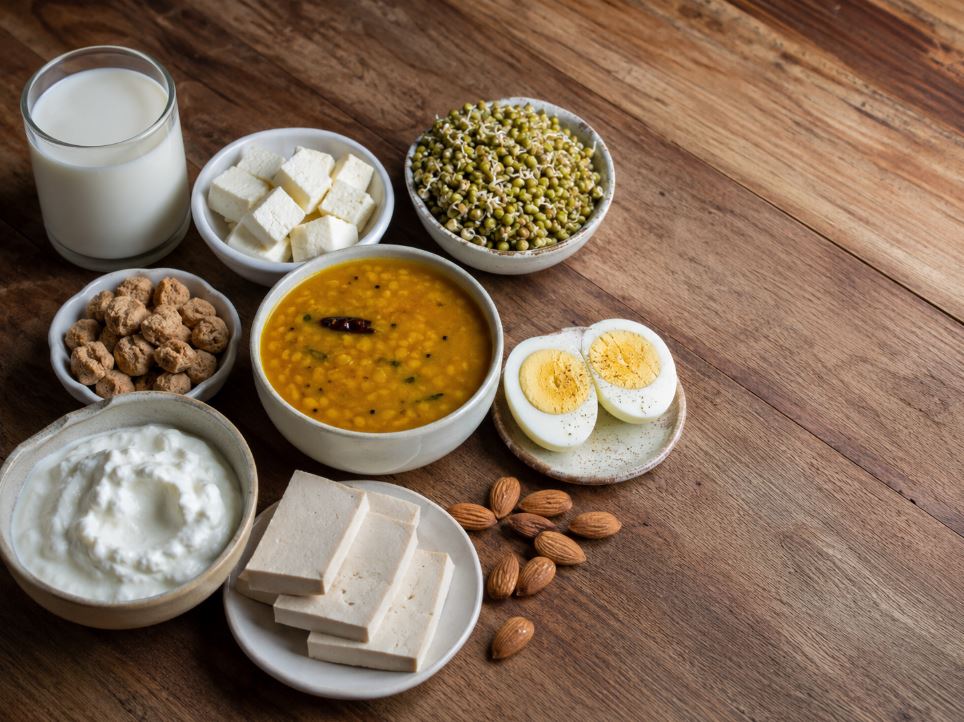
How to hit 100g+ of protein on a vegetarian Indian diet (the complete guide)
A practical, evidence-based guide to hitting 100g+ protein on a vegetarian Indian diet. Real foods, real katoris, three sample days, Jain and vegan notes.
Editorially reviewed
Bassam Mallick · Last reviewed 16 May 2026
Master Nutrition Coach · MSc Kinesiology, Sports & Performance Nutrition · Lifestyle & Metabolic Medicine, Harvard Medical School
The single most common message I get from vegetarian clients — usually a few weeks into coaching — is some version of this:
"Bassam, I'm doing everything you said. I'm tracking, I'm eating clean, I'm in a deficit. But I cannot get past 60g of protein a day. It's just dal, paneer, dal, paneer."
I get it. I've been in vegetarian households my entire life. The honest reality is that a traditional Indian thali — even a generous one — usually lands somewhere between 40 and 70g of protein for the day. That's enough to keep you alive. It is not enough to build or hold muscle, lose fat without losing strength, or recover from real training.
This guide is the full playbook I walk my vegetarian clients through. It's long on purpose. If you read it once and apply the structure, you should never have to ask the "how do I hit my protein?" question again.
The honest problem with vegetarian Indian eating
Indian vegetarian food is not low protein because Indian cooks did something wrong. It's low protein because the plate is built around grain and starch. A typical lunch in most homes I've seen looks like:
- 2 rotis (≈6g protein)
- 1 katori dal (≈6g)
- 1 katori sabzi (≈2g)
- 1 katori rice (≈4g)
- curd or pickle on the side (≈3g)
That's roughly 20g of protein and 600+ calories. The macros are upside down — most of the calories come from wheat and rice, and protein is whatever happens to come along for the ride.
Multiply that across three meals and you're at 50–60g for the day. Add a chai with biscuits, a samosa in the evening, and now you've added another 400 calories and almost no protein.
This isn't a tradition problem. It's a portion-shape problem. The fix isn't to eat less Indian food — it's to rebuild the shape of the plate so protein leads and starch follows.
How much protein do you actually need?
The lazy answer that gets repeated everywhere is "1g per pound." That's a rough-and-ready bodybuilder rule, not a medical recommendation. The evidence base for active adults consistently lands in a narrower range:
- 1.2–1.4 g/kg if you're sedentary and just want general health
- 1.6–1.8 g/kg if you train three to five times a week
- 1.8–2.2 g/kg if you're cutting fat and trying to hold every gram of muscle
- 2.0–2.4 g/kg for older adults (50+) to push back against age-related muscle loss
The meta-analytic evidence is clear that the muscle-building benefit of protein plateaus at roughly 1.6 g/kg for most trained adults — eating well past that adds calories, not muscle (Morton 2018).
I cover this in more depth in how much protein do you actually need. For this guide, let's just work two examples:
A 60kg woman training three to four times a week: Target = 60 × 1.6 = 96g, round up to 100g/day. That's 25g of protein at four eating windows. Achievable.
A 75kg man training hard and trying to gain muscle: Target = 75 × 1.8 = 135g/day. That's 30–35g of protein at four windows, or 25g across five.
Notice how neither number is 200g. The internet has convinced people that protein targets are bigger than they are. Most vegetarian adults in India are aiming for somewhere between 90g and 140g — and almost all of that range is reachable on a vegetarian Indian plate, if the plate is built correctly.
A note on kidneys, briefly: in healthy adults, the "high protein wrecks your kidneys" claim does not hold up. If you have diagnosed kidney disease, this advice does not apply to you — talk to your nephrologist before changing your intake. The rest of this guide assumes you're a healthy adult.
The Indian protein ranking table
This is the table I wish someone had handed me ten years ago. Real Indian foods, realistic portions, honest numbers (rounded so you can actually use them). Bookmark this.
| Food | Portion | Protein | Calories |
|---|---|---|---|
| Soya chunks (dry) | 50g (≈1.5 cups cooked) | 26g | 170 |
| Paneer (full fat) | 100g | 18g | 270 |
| Tofu (firm) | 150g | 18g | 200 |
| Whey isolate | 1 scoop (30g) | 24g | 110 |
| Plant protein blend | 1 scoop (30g) | 22g | 120 |
| Greek / hung curd | 150g | 15g | 100 |
| Whole eggs (eggetarian) | 2 large | 12g | 145 |
| Egg whites | 4 whites | 14g | 70 |
| Moong dal (cooked) | 1 katori | 9g | 110 |
| Urad dal (cooked) | 1 katori | 9g | 120 |
| Chana / rajma (cooked) | 1 katori | 12g | 180 |
| Mixed sprouts | 1 cup | 10g | 130 |
| Peanuts (roasted) | 30g | 8g | 170 |
| Almonds | 30g (≈23 pieces) | 6g | 175 |
| Milk (toned) | 1 glass (250ml) | 8g | 110 |
| Curd (regular dahi) | 1 katori | 5g | 80 |
| Roti (whole wheat) | 1 medium | 3g | 80 |
| Rice (cooked) | 1 katori | 4g | 200 |
Three things to notice:
Soya chunks are the silent winner. 50g of dry chunks — which puffs up into a fairly large bowl of curry — gives you 26g of protein for 170 calories. There is no other vegetarian Indian staple that hits that protein-to-calorie ratio. Outside of allergy or thyroid concerns (more on the myth below), soya is the single most useful ingredient I introduce to vegetarian clients.
Regular dahi is not Greek curd. A katori of normal Indian dahi is 5g of protein. The same volume of hung curd or Greek-style strained curd is 15g. Strain your dahi overnight in a muslin cloth — same food, three times the protein.
Dal is dinner support, not dinner. One katori of dal is 9g of protein. People say "we eat dal every day" as if that solves it. It contributes — but it cannot be the protein anchor of the meal. Pair it with a real protein source.
The two structural fixes
After looking at hundreds of food logs from vegetarian clients, almost every protein gap comes down to two structural problems. Fix these and the rest is just execution.
Fix 1: Protein at every meal, not just dinner
The most common pattern I see: a chai-and-biscuit breakfast (3g protein), a dal-rice-sabzi lunch (15g), and then a panicked attempt to "make up for it" with a giant paneer dinner. Even with a heroic dinner, you cap out around 60g for the day.
Muscle protein synthesis is meal-by-meal, not daily total. You want 20–35g of protein at each of three or four eating windows. That's the structural target. If a meal has under 15g of protein, it's not a meal — it's a snack that thinks it's a meal.
The fix isn't to eat less Indian food — it's to rebuild the shape of the plate so protein leads and starch follows.
Fix 2: Breakfast is where most vegetarian Indian totals die
Look at a typical Indian vegetarian breakfast: poha, upma, paratha with pickle, idli sambar, dosa, bread-jam, cornflakes. Almost all of these are 5–10g of protein. You start the day in a 20g hole that you'll spend the next sixteen hours trying to climb out of.
Breakfast is the single highest-leverage meal to fix. Some options I rotate with clients:
- Paneer bhurji + 1 roti (≈25g)
- Tofu scramble with onion-tomato masala + 1 multigrain toast (≈22g)
- Besan chilla (2) stuffed with paneer (≈24g)
- Sprouts chaat + 150g hung curd on the side (≈30g)
- Oats cooked in milk + 1 scoop whey + peanut butter (≈35g)
- Eggs (for eggetarians): 3-egg masala omelette + 1 toast (≈25g)
If you only change one thing after reading this guide, change breakfast. I've had clients add 30g to their daily protein total just by swapping poha for paneer bhurji twice a week.
I cover more breakfast options and full meal builds in indian vegetarian high-protein meals.
A real day, at three calorie targets
These are not theoretical. These are templates I've used with actual vegetarian clients. All three hit 100g+ of protein from regular Indian food.
1,600 kcal day — fat loss, ~60kg woman (target: 100g protein)
| Meal | Food | Protein | Calories |
|---|---|---|---|
| Breakfast | Paneer bhurji (100g paneer) + 1 roti | 22g | 380 |
| Mid-morning | 150g hung curd + 10g almonds | 17g | 170 |
| Lunch | Soya chunk curry (50g dry) + 1 roti + salad | 30g | 400 |
| Snack | 1 scoop whey in water + 1 fruit | 25g | 200 |
| Dinner | Tofu stir-fry (150g) + small bowl moong dal | 25g | 450 |
| Total | 119g | 1,600 |
2,000 kcal day — maintenance, ~70kg adult (target: 120g protein)
| Meal | Food | Protein | Calories |
|---|---|---|---|
| Breakfast | Oats (50g) in milk + 1 scoop whey + 1 tsp peanut butter | 35g | 450 |
| Lunch | Rajma (1.5 katori) + 1 katori brown rice + 60g paneer + raita | 35g | 700 |
| Snack | Sprouts chaat (1 cup) + 150g hung curd | 25g | 280 |
| Dinner | Palak tofu (150g tofu) + 2 rotis + sabzi | 28g | 570 |
| Total | 123g | 2,000 |
2,400 kcal day — muscle gain, ~75kg man (target: 135g protein)
| Meal | Food | Protein | Calories |
|---|---|---|---|
| Breakfast | Besan chilla (3) + 150g paneer filling + 1 glass milk | 38g | 600 |
| Lunch | Soya chunk curry (60g dry) + 1.5 katori rice + dal + curd | 40g | 800 |
| Snack | 1 scoop whey + 30g roasted chana + 1 banana | 32g | 400 |
| Dinner | Paneer tikka (150g) + 2 rotis + sabzi + raita | 32g | 600 |
| Total | 142g | 2,400 |
These aren't sample-of-the-day Instagram posts. They're the same five or six ingredients rotated intelligently. That's the whole game — boring rotation, executed daily.
If you want a deeper, week-by-week version of this kind of plan built around real grocery lists and Indian portions, that's exactly what I built The Indian Macro Cookbook for. For muscle gain specifically, The Bulking Bible goes much deeper into progressive calorie increases. For fat loss, The 12-Week Fat Loss Manual handles the deficit math.
The Jain section
For Jain readers, the building blocks narrow but they don't disappear. What stays on the table:
- Paneer, tofu, soya — all three are unrestricted and remain your protein anchors
- All dairy — milk, curd, hung curd, whey
- Pulses and legumes — dal, chana, rajma, moong (above-ground)
- Sprouts — depending on your school of practice; many strict Jain households avoid these, so check with your family practice
- Whey and plant protein — fine, as long as the plant blend isn't onion/garlic-flavoured or root-derived (most pea/rice/hemp blends are fine; double-check the label)
What changes: onion-garlic-free cooking changes flavour, not protein content. Paneer bhurji works beautifully with just ginger, green chilli, and tomato. Soya chunks take to a tomato-asafoetida base extremely well. Use hing, ginger, green chilli, curry leaves, cumin, and dry spices — the protein math doesn't move at all.
What stays the same: every protein number in the table above still applies. A Jain client of mine hits 130g a day, every day, on paneer-tofu-soya-dahi-whey alone.
Vegan-specific notes
If you're vegan, drop paneer, dairy, whey, and (for many) eggs. Your protein anchors become:
- Tofu (the biggest single mover)
- Soya chunks
- Tempeh (if you can find it — uncommon in most Indian cities, but growing)
- Plant protein powder — pea isolate, rice protein, or a blended formula
- Pulses, legumes, sprouts as supporting players
- Seitan if wheat-tolerant
The protein side is genuinely doable. With tofu, soya, and a scoop of plant protein, a vegan 70kg adult can hit 130g without breaking a sweat.
The honest weak spots on a vegan Indian diet are not protein — they're elsewhere:
- Vitamin B12 — not present in any plant food at meaningful levels. Food fortification is patchy in India. This is the one supplement I tell every vegan client to take, no debate. A weekly methylcobalamin tablet is enough for most people; confirm dosage with your doctor.
- Omega-3 (specifically EPA/DHA) — flaxseed, chia, and walnuts give you ALA, only a small fraction of which converts to EPA/DHA. If you're vegan and not eating these consistently, a microalgae-derived omega-3 supplement is a reasonable choice.
- Vitamin D, iron, zinc, iodine — worth a once-a-year blood panel to check, especially if you're training hard.
Food-first is still the right framing. Supplements close gaps; they do not replace structure.
Common myths, handled honestly
Myth: vegetarian proteins are "incomplete" so you need to combine them perfectly at every meal. Outdated. The "complementary protein at every meal" framing came from a 1971 book that the author herself later retracted. The Academy of Nutrition and Dietetics' position on vegetarian diets states plainly that protein needs are met without combining foods, as long as intake is adequate and varied across the day (Melina 2016). The body has a free amino acid pool that handles this for you. Eat dal at lunch and curd at dinner — you're fine.
Myth: soya wrecks testosterone / causes "man-boobs" / messes with hormones. This one will not die. The actual evidence: a meta-analysis of clinical studies found neither soy protein nor isoflavones significantly altered testosterone or estrogen in men at normal dietary intakes (Hamilton-Reeves 2010). The handful of case reports involved men eating extreme amounts — 12+ servings a day. A normal Indian portion of soya chunks two to four times a week is genuinely fine for both men and women.
Myth: high protein damages your kidneys. In healthy adults, no. The "renal load" worry comes from extrapolating studies in people who already had kidney disease. A systematic review and meta-analysis found higher-protein diets do not adversely affect kidney function in healthy adults (Devries 2018). If you have pre-existing kidney disease, this whole article does not apply — talk to your doctor.
Myth: more protein = more muscle. There's a ceiling. Beyond roughly 1.6–2.2 g/kg, additional protein gives diminishing returns. The extra calories from "more protein" still count. Hitting 200g when your target is 130g doesn't build more muscle; it just makes you fuller.
The supplements honest take
I save this for the end because it matters least. Whey or plant protein is a gap-filler, not a magic ingredient. If your food-side protein lands you at 75g and your target is 110g, one or two scoops of whey closes the gap cheaply. That's the entire pitch.
What to look for: 20–25g of protein per scoop, under 130 calories, minimal added sugar, a recognised brand that does third-party testing. Whey isolate if you're lactose-sensitive; whey concentrate is fine for most people. For plant blends, prefer a multi-source blend (pea + rice + hemp) over single-source — the amino acid profile is better.
What to ignore: BCAAs, EAAs, "anabolic" creatine stacks marketed at vegetarians, "muscle-builder" mass-gainers loaded with sugar and maltodextrin, anything claiming to "boost protein synthesis 300%."
Creatine is the one supplement with more evidence than whey. 3–5g a day, monohydrate, any brand that's been third-party tested. That's it. Especially relevant for vegetarians, who tend to have lower baseline muscle creatine because we don't eat meat.
When you genuinely cannot hit the number
Sometimes a client cannot hit 1.6 g/kg vegetarian. Maybe they're traveling constantly, eating at relatives' homes most nights, or just have a stubbornly low appetite. The honest call in that case is one of three:
- Lower the target slightly. 1.4 g/kg eaten consistently beats 1.8 g/kg eaten three days a week. A 60kg woman hitting 85g every day will keep more muscle than the same woman hitting 110g on Monday and 50g the rest of the week.
- Add eggs. If you're an eggetarian or open to it, two whole eggs at breakfast solves an enormous amount of the math. 12g of protein for 145 calories with almost no planning.
- Add one scoop of whey. 25g of protein from one scoop is the single highest-leverage food intervention available.
What is not the answer: under-eating overall to force the protein percentage up. I see this constantly — someone hits "100g protein" on 1,200 calories and feels triumphant. They are also under-eating by 600 calories and will lose muscle, miss their period, sleep badly, and crash within six weeks.
Eat enough food. Build it around protein. Don't punish yourself into a number.
Frequently asked questions
Where to go from here
If you read this and thought okay, I get the structure, but I want someone to lay out the actual week for me: that's exactly the gap The Indian Macro Cookbook fills. Real grocery lists, real Indian portions, every meal hitting its protein number, Jain and vegan variations included. Read Chapter 1 free before deciding.
If you'd rather start free and see if the approach works for you: the diet plan builder will generate a 7-day vegetarian plan tuned to your weight, training, and protein target. Set diet preference to "Vegetarian" (or "Vegan" / "Jain" / "Eggetarian") and it'll handle the rest.
Either way: pick a number in your range, build it into four meals across the day, and run it for six weeks. The vegetarian protein problem is real, but it is also solvable. Most clients who struggled with this for years end up landing on a quiet, boring rotation of paneer-tofu-soya-dahi-whey, hitting their number every day, and never thinking about it again.
That's the goal. Boring is the win.
References
- [1]
Morton RW, Murphy KT, McKellar SR, et al. (2018). A systematic review, meta-analysis and meta-regression of the effect of protein supplementation on resistance training-induced gains in muscle mass and strength in healthy adults. British Journal of Sports Medicine, 52(6), 376–384.
View source - [2]
Melina V, Craig W, Levin S (2016). Position of the Academy of Nutrition and Dietetics: Vegetarian Diets. Journal of the Academy of Nutrition and Dietetics, 116(12), 1970–1980.
View source - [3]
Hamilton-Reeves JM, Vazquez G, Duval SJ, et al. (2010). Clinical studies show no effects of soy protein or isoflavones on reproductive hormones in men: results of a meta-analysis. Fertility and Sterility, 94(3), 997–1007.
View source - [4]
Devries MC, Sithamparapillai A, Brimble KS, et al. (2018). Changes in Kidney Function Do Not Differ between Healthy Adults Consuming Higher- Compared with Lower- or Normal-Protein Diets: A Systematic Review and Meta-Analysis. The Journal of Nutrition, 148(11), 1760–1775.
View source