
How to Choose Home Gym Equipment That You'll Actually Use
With hundreds of options on the market, buying the wrong equipment is an expensive mistake. Here's how to choose gear that fits your goals, space, and budget.

Editorially reviewed
Bassam Mallick · Last reviewed 28 October 2020
Master Nutrition Coach · MSc Kinesiology, Sports & Performance Nutrition · Lifestyle & Metabolic Medicine, Harvard Medical School
One of the most common WhatsApp messages I get goes something like this: “I want to start working out at home. There's a sale on this ₹38,000 multi-station. Should I get it?” The honest answer almost always disappoints the person asking — no, don't get it, and the reason isn't the price.
In a decade of helping clients set up home gyms across small Mumbai apartments, suburban Bangalore villas, Gulf-country compounds and one-bedroom college flats, the pattern is the same: the elaborate equipment buyers stop using it inside three months. The minimal equipment buyers — adjustable dumbbells, a bench, a pull-up bar, a mat — are still training off it five years later. The best home gym equipment isn't the most expensive or the most feature-rich; it's the equipment you'll still touch on a Tuesday evening when you're tired and would rather not.
Setting up a home gym sounds straightforward until you're standing in a sports store surrounded by treadmills, resistance bands, kettlebells, and cable machines — each one promising to transform your body. The truth is, the best home gym equipment is not the most expensive or the most feature-rich; it's the equipment that matches your specific goals and that you'll consistently show up for. Get this decision right and you'll save money, space, and months of frustration.
Start With Your Goal, Not a Brand Name
Before you compare prices or read a single review, get clear on what you actually want to achieve. Are you trying to lose body fat, build muscle, improve cardiovascular endurance, or simply stay active on days you can't make it to the gym? Your goal determines your equipment — not the other way around. A person whose primary aim is improving aerobic fitness has almost no use for a 100 kg barbell set, and someone focused on hypertrophy won't get much from a treadmill alone. Write your goal down. Keep it specific. That single step will filter out at least half the options you'd otherwise waste time considering.
Cardio Equipment: What's Worth the Space
Cardiovascular training is the foundation of almost every fitness goal — fat loss, heart health, and even recovery between strength sessions. The three most practical options for home use are:
- Treadmill: The most intuitive piece of cardio kit. Ideal if you enjoy walking or running and want to control pace, incline, and distance precisely. Look for a motor rated at least 2.5 CHP for running use.
- Elliptical trainer: Low impact on the knees and hips, making it an excellent choice if you have joint concerns. It recruits both the upper and lower body simultaneously, which increases calorie expenditure without added stress.
- Stationary or spin bike: Compact, quiet, and highly effective for interval training. A good spin bike is often the most space-efficient cardio investment you can make in an Indian apartment.
If space is genuinely limited, a quality jump rope and a set of resistance bands can deliver surprisingly effective cardio and cost a fraction of a machine — worth considering before you commit to anything bulky.
Strength Training Equipment: Build What You Need
Resistance training preserves and builds muscle, supports bone density, and keeps your metabolism working efficiently as you age. You don't need a full rack of machines to get results at home.
Dumbbells and adjustable sets
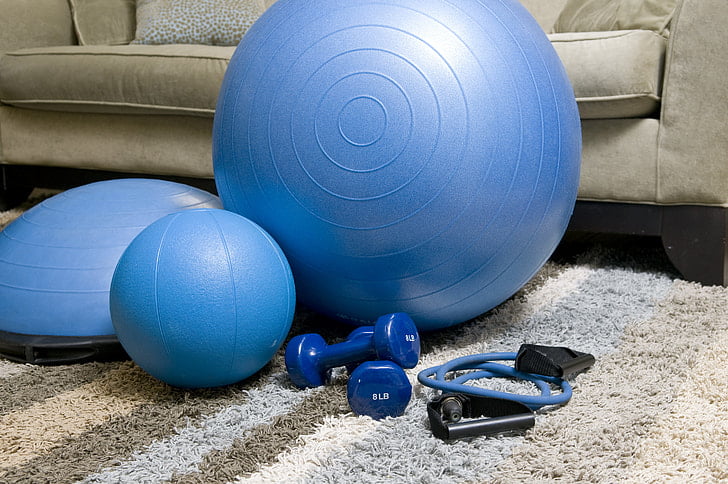
A set of adjustable dumbbells is arguably the single most versatile investment for a home gym. They replace an entire rack, take up minimal floor space, and cover everything from shoulder presses to Romanian deadlifts. Opt for a set that adjusts from roughly 5 kg to 32 kg — that range handles the vast majority of exercises for most people.
Resistance bands
Underrated and underused. Resistance bands add variable tension through a movement, which challenges muscles differently from free weights. They're ideal for warm-ups, mobility work, and adding difficulty to bodyweight exercises like pull-ups and dips.
A pull-up bar and bench
A doorframe pull-up bar costs under ₹1,000 and trains your back, biceps, and core. Pair it with a flat or adjustable bench and you've created the foundation for a comprehensive upper-body programme without needing a single machine.
The best piece of equipment is not the one with the most settings — it's the one you use consistently, week after week.
Avoid These Common Buying Mistakes
The home fitness equipment market is crowded, and aggressive marketing makes it easy to spend money on things you don't need. Watch out for these pitfalls:
- Buying for aspirational goals rather than current habits. If you don't run outdoors now, a ₹80,000 treadmill won't change that overnight.
- Ignoring build quality for a lower price. Cheap cable machines and treadmills tend to break within a year of regular use. Read verified user reviews and check warranty terms — a minimum two-year warranty on motorised equipment is a reasonable expectation.
- Overlooking space requirements. Measure your available floor area before purchasing. Account for clearance space around the equipment, not just its footprint on paper.
- Chasing gadgets over fundamentals. A treadmill with a touchscreen is useless if the belt motor is underpowered. Prioritise mechanical quality over digital features.
Nutrition Is Not Optional
No piece of equipment will compensate for a poor diet. Whether your goal is fat loss or muscle gain, what you eat determines the majority of your results. Severely restricting food — skipping meals or cutting entire food groups — deprives your body of the protein, micronutrients, and energy it needs to recover and adapt. The effective approach is straightforward: eat enough protein (roughly 1.6–2.2 g per kg of bodyweight for active individuals), prioritise whole foods, and maintain a moderate caloric deficit or surplus depending on your goal. Equipment accelerates progress; nutrition makes progress possible.
Key Takeaways
- Define your fitness goal first — it determines which equipment you actually need.
- For cardio, match the machine to your preference and joint health; ellipticals and bikes are gentler options than treadmills.
- Adjustable dumbbells, resistance bands, and a pull-up bar form a highly effective and space-efficient strength training setup.
- Prioritise build quality and warranty over brand name or flashy features.
- Consistent training paired with good nutrition will always outperform expensive equipment used sporadically.
Building a home gym is one of the smartest long-term investments you can make in your health — but only if you buy with intention. Start with one or two well-chosen pieces, use them consistently, and expand from there. Progress, not equipment, is the goal.
Get the weekly note.
Evidence-based nutrition + training, India-context, no fluff. One email a week from Bassam. Unsubscribe anytime.
Keep reading

Walking for fat loss: why 10,000 steps beats hours of cardio (and how to actually use it)
Walking is the most underrated fat-loss tool in fitness. Here's the science behind NEAT, the truth about the 10,000-step number, and how to use walking in Indian cities.
Read
Gaining Weight? Here's How to Turn It Around for Good
Weight gain is rarely just about willpower. Understanding the real drivers — and fixing them systematically — is how lasting change actually happens.
Read
Home Workouts vs Gym: Which Gets You Faster Results?
The gym vs. home debate isn't really about location — it's about effort, structure, and consistency. Here's how to make either work for you.
Read