
Looking Sharp Starts Inside: The Fitness, Sleep and Nutrition Foundation of Men's Grooming
No serum, beard oil or styling product fixes what bad sleep, poor nutrition and zero training are doing to your skin, hair, jaw and posture. The foundation comes from underneath. Here's the actual stack.


Editorially reviewed
Bassam Mallick · Last reviewed 26 May 2023
Master Nutrition Coach · MSc Kinesiology, Sports & Performance Nutrition · Lifestyle & Metabolic Medicine, Harvard Medical School
I've watched men spend ₹15,000 on grooming products in a month and still look tired in photographs. I've watched other men with one bar of soap and a barber's trimmer look composed and energetic at 45. The difference between the two groups isn't the bathroom shelf. It's what's happening underneath the haircut.
After more than a decade of coaching male clients across India and the Gulf, the pattern is consistent. The men who appear physically present — clear skin, defined jaw, alert eyes, easy posture — are almost always doing four things underneath the grooming, and most of them don't know they're doing them. The men who look chronically depleted have invariably skipped or broken at least three of those four. Grooming on top of a depleted foundation is paint on a damp wall. It looks fine for a few hours and then the truth shows through.
The four underneath-the-grooming levers
1. Sleep, before anything else
The single biggest input into how your face looks is how you slept last night, and how you've slept on average for the last six weeks. Short sleep elevates cortisol, suppresses growth hormone, drops skin barrier function and prints itself as dark under-eye circles, puffy lids, sallow complexion and the slight downturn of the mouth that reads as “unwell” even to people who can't articulate why. The clinical evidence is well-documented: Oyetakin-White et al. 2015 showed that adults averaging under 5 hours of sleep had measurably worse skin barrier function, slower recovery from UV exposure, and higher self-rated and observer-rated “tired-looking face” ratings vs adults averaging 7–9 hours. Seven to nine hours, consistent wake time, room actually dark, screens off the last 60 minutes. No serum competes with this.
2. Strength training, two to three sessions a week
This is the lever men most consistently underestimate. Strength training does three things to how you present that no product touches. It builds the upper back and rear deltoids that hold your shoulders back instead of letting them roll forward into the desk-worker slump. It tightens the jaw and neck line by raising overall lean mass and dropping visceral fat. And it changes posture — the calm, square-shouldered, chest-open posture that reads as authority is built in the gym, not taught by a stylist. The weight-loss planner + a sensible strength program is more transformative for “how you look in a meeting” than any haircut.
3. Nutrition that actually feeds skin and hair
Hair and skin are protein structures. They are also among the first tissues your body deprioritises when it's short on the building blocks. The signs are familiar to anyone who's eaten badly for a long stretch — thinning crown, brittle hair shafts, dull complexion, slow wound healing. Three nutritional anchors matter more than anything else in your bathroom:
- Protein at 1.6–2.2 g/kg of body weight, daily. Without it, hair and skin renewal slow. Use the protein calculator to set your number.
- Adequate B12, iron, zinc and biotin. Indian vegetarian and quasi-vegetarian diets are especially prone to deficiency in these. A simple annual blood panel will tell you what's missing.
- Omega-3 fats — 2–3 g/day. Fatty fish twice a week, or a quality fish-oil supplement. Reduces inflammatory skin presentation and supports scalp health.
4. Walking and sunlight, daily
15–20 minutes of morning sunlight on the face does more for circadian rhythm, mood and skin tone than any topical product. 8,000+ daily steps reduces visceral fat (which prints as facial puffiness), drives lymphatic drainage and clears insulin from circulation. Both are free and both compound. The steps calculator shows the actual mortality and metabolic upside.
The grooming layer that goes on top
With the underneath sorted, here's the simplest external routine I recommend to clients. Five products, ten minutes of effort, no daily mirror marathon.
- Cleanse morning and night with a gentle pH-balanced face wash. Removes pollution and excess oil without stripping the skin barrier.
- Moisturise while skin is still slightly damp. Gel formula for oily skin, lotion for normal-to-dry.
- Sunscreen — broad-spectrum SPF 30 or higher, every single morning, indoors and out. UV is the single biggest driver of premature skin ageing and it accumulates whether it's cloudy or not.
- Shaving — warm water prep, sharp blade (replace every 5–7 shaves), with the grain not against it, finish cold-water rinse and a fragrance-free balm. Mastering with-the-grain is the single fix for most razor burn complaints.
- Hair — wash 2–4 times a week (daily strips natural oils), trim every 4–6 weeks. Dandruff: shampoo with zinc pyrithione or ketoconazole. Visible thinning: see a dermatologist sooner rather than later — early intervention produces far better results.
That's it. Anything beyond this is optional optimisation — and almost always returns less than the underneath work. The men who spend the next three months fixing their sleep, protein, training and walking before they upgrade a single grooming product invariably look more transformed at the end than the men who do the reverse.
The men who appear physically present at 45 — clear skin, defined jaw, easy posture — almost always built that underneath first. Grooming on top of a depleted foundation is paint on a damp wall.
Frequently asked questions
I'm balding. Will fixing sleep and nutrition reverse it?
Probably not — male-pattern baldness is largely genetic (androgenetic alopecia, driven by DHT sensitivity in scalp follicles). What fixing the foundation can do: prevent the diffuse thinning that compounds genetic loss, slow the rate, and rule out the reversible causes (low iron, low B12, hypothyroidism, severe stress) before assuming it's purely genetic. If you're visibly losing hair, see a dermatologist — minoxidil + finasteride have decades of clinical evidence behind them and work best when started early.
How long until the “fix the foundation” approach shows visible change?
Sleep effects (under-eye darkness, skin tone) show within 2–4 weeks of consistent 7–9 hour nights. Protein and nutrition effects on hair quality and skin renewal take longer — hair grows ~1 cm/month, so visible quality changes appear at 8–12 weeks. Strength training effects on posture and jawline appear in 8–16 weeks. The whole package is closer to a 3-month commitment than a 3-week one.
Is sunscreen really necessary daily, even indoors?
Yes for two reasons. First, UVA (the longer-wavelength, ageing-driving UV) penetrates window glass and accumulates exposure during commute, near windows, and outdoors. Second, the “you only need it on sunny days” framing is responsible for most premature skin ageing in adults under 40. Broad-spectrum SPF 30+ daily, regardless of weather, is the highest-leverage skin-ageing intervention in the routine. Skip it and the rest matters less.
What about supplements — biotin, collagen, multivitamins?
Biotin: useful only if you're genuinely deficient (rare without a malabsorption issue), otherwise expensive urine. Collagen: emerging evidence supports it for skin elasticity and hair quality at 10 g/day, particularly for adults over 35 — but a high-protein diet largely covers the precursor amino acids. Multivitamins: useful as insurance against B12, D, and zinc shortfall in Indian male vegetarian diets — get a basic blood panel first and supplement what's actually low, rather than taking a 60-ingredient product blindly.
References
- Oyetakin-White P, Suggs A, Koo B, et al. Does poor sleep quality affect skin ageing? Clin Exp Dermatol. 2015;40(1):17-22. PubMed
- Walker MA. Why We Sleep: The New Science of Sleep and Dreams. New York: Scribner; 2017. Foundational review of sleep's effects on cortisol, growth hormone, and tissue repair pathways.
- Morton RW, Murphy KT, McKellar SR, et al. A systematic review, meta-analysis and meta-regression of the effect of protein supplementation on resistance training-induced gains. Br J Sports Med. 2018;52(6):376-384. PubMed
Get the weekly note.
Evidence-based nutrition + training, India-context, no fluff. One email a week from Bassam. Unsubscribe anytime.
Keep reading
- 🫒
The Mediterranean diet adapted for the Indian kitchen (complete guide)
The Mediterranean diet — the most evidence-supported eating pattern in the world — translated honestly into Indian kitchens. The trial evidence, what stays, what swaps, the oils, and a real Indian-Med day.
Read - 🍬
Sugar-free diet: what it actually means and how to do it honestly
What a sugar-free diet really means — added vs natural sugars, where sugar hides in an Indian diet (with grams), the three honest levels, and a realistic 30-day plan you can keep.
Read 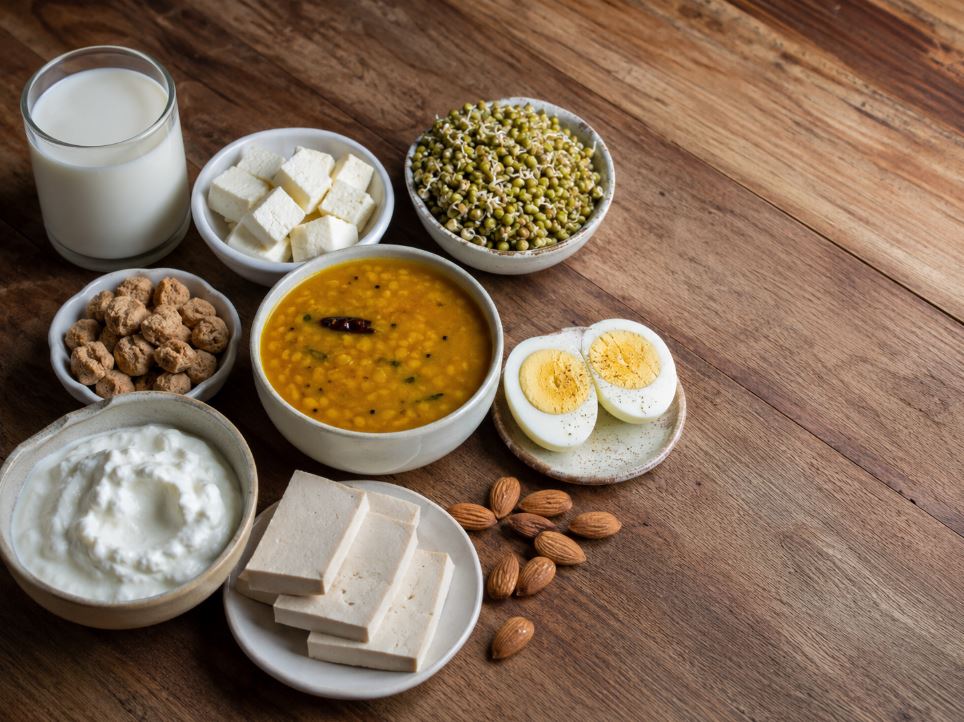
How to hit 100g+ of protein on a vegetarian Indian diet (the complete guide)
A practical, evidence-based guide to hitting 100g+ protein on a vegetarian Indian diet. Real foods, real katoris, three sample days, Jain and vegan notes.
Read