
How to Keep Your Skin Healthy When You're Stuck Indoors
Disrupted routines, stress, and less movement can all show up on your skin. Here's how to protect it without leaving home.

Editorially reviewed
Bassam Mallick · Last reviewed 28 October 2020
Master Nutrition Coach · MSc Kinesiology, Sports & Performance Nutrition · Lifestyle & Metabolic Medicine, Harvard Medical School
One of the quieter side effects of the work-from-home shift, and of the general migration of urban Indian life indoors, has been a small wave of skin complaints I started hearing across coaching consultations. The pattern is familiar: clear-skinned clients who used to walk to the metro and eat lunch outdoors are suddenly dealing with breakouts at 38, dull complexion that no serum touches, fine lines that weren't there 18 months ago. They blame the new face wash. The new face wash is rarely the problem.
Spending most of your day indoors — whether through remote work, scorching weather, a quieter season of life, or just the modern apartment-and-car commute — does more to your skin than most people expect. Less movement, disrupted sleep, stress-driven eating, stale air, blue-light overdose and chronic dehydration all collectively trigger breakouts, dullness and accelerated ageing. The good news is that the fundamentals of good skin health are entirely within your control at home, and almost all of them cost nothing.
Hydration Is the Foundation
Water is the simplest, most evidence-backed thing you can do for your skin. Adequate hydration supports circulation, helps your body clear metabolic waste, and keeps the skin's barrier function intact. Aim for roughly 2.5–3.5 litres per day depending on your body weight and activity level — the old "eight glasses" rule is a rough guide, not a precise target.
If plain water bores you, herbal teas, coconut water, and water-rich foods like cucumber, watermelon, and oranges all count toward your daily intake. What doesn't help: sugary drinks and excessive caffeine, both of which can impair hydration at the cellular level.
Eat for Your Skin, Not Just for Comfort
It's tempting to lean on ultra-processed comfort foods when you're cooped up, but your skin will reflect those choices within days. A diet that supports skin health doesn't require exotic ingredients — just a consistent emphasis on:
- Fatty fish (salmon, mackerel, sardines) — rich in omega-3s that reduce inflammation and keep the skin supple
- Leafy greens and colourful vegetables — packed with antioxidants that neutralise free radicals
- Berries — high in vitamin C, which is essential for collagen synthesis
- Walnuts and pumpkin seeds — good sources of zinc and vitamin E, both linked to clearer skin
- Whole grains over refined carbohydrates — high-glycaemic foods are consistently associated with acne in research
If you can cook at home rather than ordering in, do it. You control the oil, the salt, and the ingredients — and your skin will notice the difference.
Move Your Body Every Single Day
Skipping exercise doesn't just affect your fitness — it directly affects your skin. Physical activity increases blood flow, delivering oxygen and nutrients to skin cells and helping carry away cellular debris. That post-workout glow is physiologically real.
You don't need a gym to keep your skin nourished — a 30-minute home workout raises circulation just as effectively as any treadmill session.
You don't need equipment to get started. Bodyweight circuits, yoga, Pilates, or even a brisk session of skipping rope are all effective. Aim for at least 30 minutes of moderate movement daily. If you have a yoga mat, a resistance band, or a light pair of dumbbells, even better — but they're not prerequisites.
Manage Stress Before It Shows on Your Face
Chronic stress elevates cortisol, which in turn increases sebum production, weakens the skin barrier, and accelerates collagen breakdown. The result: breakouts, redness, and premature fine lines. Isolation and uncertainty compound this considerably.
Practical, evidence-supported ways to bring stress down include:
- Daily movement (as above — exercise is one of the best stress regulators we know of)
- A consistent sleep schedule — skin repairs itself predominantly during deep sleep; irregular hours disrupt this process
- Breathwork or meditation — even 10 minutes of focused breathing measurably lowers cortisol
- Limiting news consumption to set times rather than scrolling continuously
- Staying socially connected via calls or video — isolation is a genuine stressor, and maintaining relationships buffers it
Rethink Alcohol
Alcohol is a diuretic — it causes your body to lose more fluid than you take in. For the skin, this translates to dehydration, enlarged-looking pores, loss of elasticity, and a dull complexion. Over time, heavy drinking is also associated with rosacea flare-ups and accelerated skin ageing. If you're drinking more than usual out of boredom or stress, it's worth being honest with yourself about that pattern. Reducing intake — or cutting it out entirely for a few weeks — is one of the faster ways to see a visible improvement in how your skin looks and feels.
Build a Simple, Consistent Skincare Routine
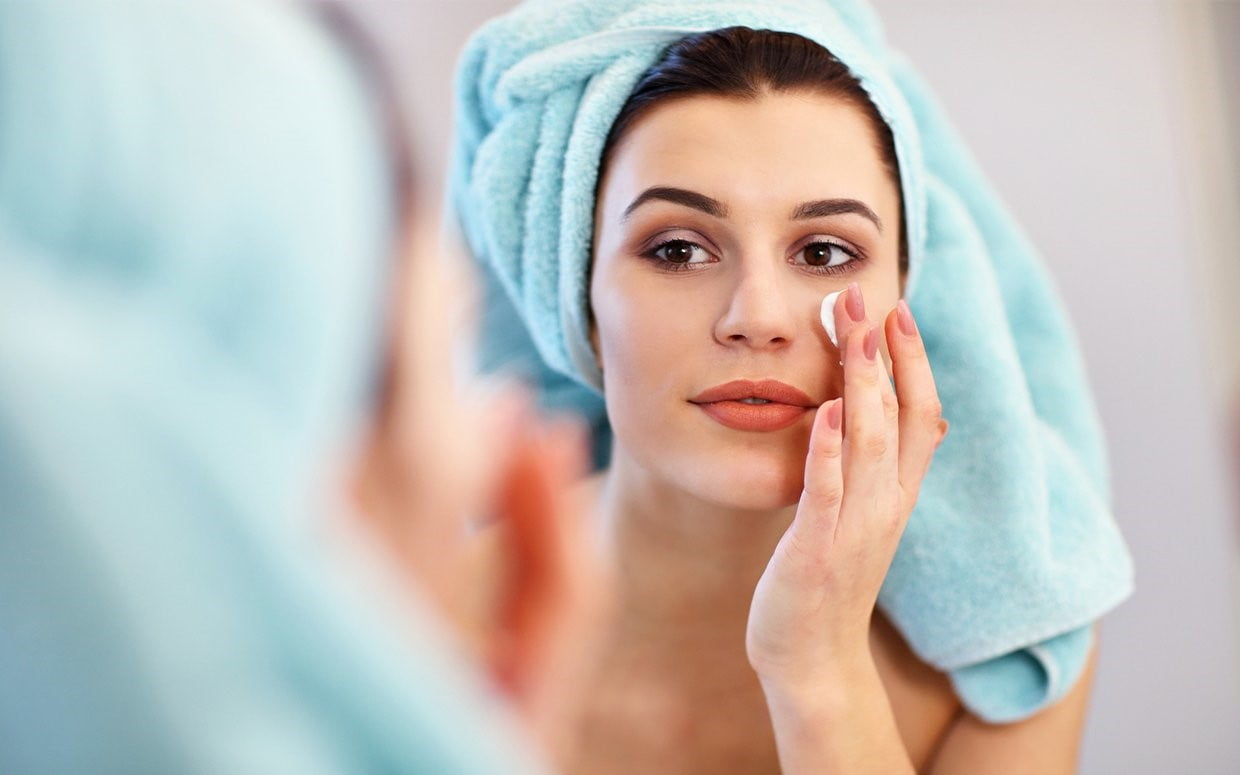
You don't need a 12-step regimen. A basic routine done consistently will outperform an elaborate one done sporadically. At minimum:
- Cleanse morning and night with a gentle, pH-balanced cleanser
- Moisturise while your skin is still slightly damp to lock in hydration
- Use SPF in the morning — UV rays come through windows, so sunscreen isn't optional just because you're indoors
If you want to go a step further, a face roller (jade, rose quartz, or stainless steel) can help with lymphatic drainage and product absorption when used correctly — roll outward and upward with light pressure. It's a genuinely relaxing ritual, and ritual itself has value for stress management.
Key Takeaways
- Drink 2.5–3.5 litres of water daily and get a significant portion from whole foods.
- Prioritise anti-inflammatory foods — fatty fish, berries, leafy greens, nuts and seeds — and minimise refined carbs.
- Move for at least 30 minutes every day; circulation is one of your skin's best friends.
- Stress and poor sleep raise cortisol, which directly drives breakouts and accelerated ageing — manage both proactively.
- Keep your skincare routine simple and consistent: cleanse, moisturise, and wear SPF even indoors.
Time at home isn't wasted time — it's an opportunity to build the habits that create genuinely healthy skin from the inside out. Start with one change today, and let momentum do the rest.
Get the weekly note.
Evidence-based nutrition + training, India-context, no fluff. One email a week from Bassam. Unsubscribe anytime.
Keep reading
- 🫒
The Mediterranean diet adapted for the Indian kitchen (complete guide)
The Mediterranean diet — the most evidence-supported eating pattern in the world — translated honestly into Indian kitchens. The trial evidence, what stays, what swaps, the oils, and a real Indian-Med day.
Read - 🍬
Sugar-free diet: what it actually means and how to do it honestly
What a sugar-free diet really means — added vs natural sugars, where sugar hides in an Indian diet (with grams), the three honest levels, and a realistic 30-day plan you can keep.
Read 
How to hit 100g+ of protein on a vegetarian Indian diet (the complete guide)
A practical, evidence-based guide to hitting 100g+ protein on a vegetarian Indian diet. Real foods, real katoris, three sample days, Jain and vegan notes.
Read