
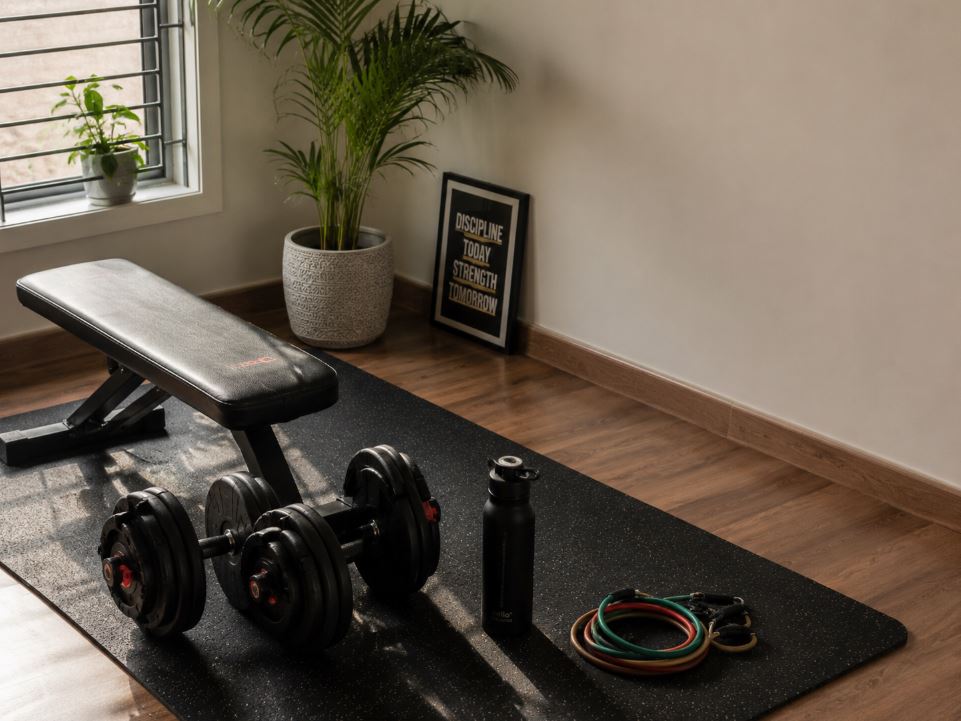
Building a home gym in an Indian apartment: the honest 2026 buyer's guide
A pragmatic, opinionated 2026 guide to building a home gym in a small Indian apartment — what to buy at every budget from ₹2k to ₹25k, what to skip, and the honest minimum setup most beginners actually need.
Editorially reviewed
Bassam Mallick · Last reviewed 22 May 2026
Master Nutrition Coach · MSc Kinesiology, Sports & Performance Nutrition · Lifestyle & Metabolic Medicine, Harvard Medical School
I've helped clients set up dozens of these in 2BHK Mumbai flats, Bangalore service apartments, and one memorable Gurgaon balcony. The pattern is always the same: people overspend on the wrong things, ignore the floor, buy a treadmill that becomes a coat rack within four months, and never quite get the rack-and-bench setup they actually wanted.
This guide is the conversation I have with every one of those clients before they put a rupee on Amazon. It is not sponsored. This site does not sell equipment. I have no affiliate links and no reason to push you toward any brand. My only goal is that you end up training consistently in your own home, in your own square footage, without your downstairs neighbour banging the ceiling.
Let's get into it.
Why a home gym usually beats a commercial gym for beginners
Most people who quit going to the gym don't quit because of the workout. They quit because of the friction stack: changing clothes, locking the door, finding shoes, the auto ride or the parking, the awkward waiting for a bench, the shower at the gym, the ride home. A 45-minute workout costs them two hours and a small dose of social anxiety. Three weeks of that and the membership is dead.
A home setup collapses that stack to zero. The barbell is six feet from where you're sitting. You can train in a t-shirt and shorts. You can do a 25-minute session at 7 a.m. before your laptop opens, or break it across two 15-minute blocks. The number of sessions you actually complete in a year is what builds the body — not how fancy the equipment is — and home setups get used roughly two to three times more often than gym memberships, in my experience.
The money math also lands hard once you do it on paper. A decent gym in a metro is ₹15,000–₹30,000 a year. A serious apartment setup is a one-time ₹10,000–₹25,000. Two years in, the home gym is already saving you money and the equipment still has a decade of life in it. A starter setup at ₹2,000–₹5,000 pays for itself in two months.
When a home gym does NOT beat a commercial gym
I'll be honest with people I've turned away from this entire idea. Three readers should stop reading and go re-up the gym membership:
- You genuinely need the accountability of others around you. The social pressure of a packed 6 p.m. gym floor is a real performance enhancer for some people, and there's no shame in needing it. If training alone in your bedroom feels like nothing happens, the gym is doing more work than you realise.
- You're an intermediate-to-advanced lifter chasing big numbers. Once you're squatting 130kg and deadlifting 180, the cost of a home setup that can safely handle you — power rack, calibrated plates, competition bar — climbs past ₹80,000 fast, and most apartments can't take the floor loading anyway.
- You actively enjoy the gym as a place. If you like the atmosphere, the music, the post-workout chai with a training partner — keep it. The best gym is the one you don't dread.
For everyone else — beginners, returners, busy professionals, parents, anyone whose biggest enemy is consistency — keep reading.
The Indian apartment constraints you must plan around
Before you buy anything, walk through your space and audit four things. This is where 90% of the regret comes from.
Floor protection is non-negotiable. Most Indian apartments have marble, vitrified tile, or polished granite. All three crack under a dropped dumbbell. Even a controlled set-down of a 20kg fixed dumbbell will chip the surface over months. A 6mm or 10mm rubber gym mat (about 6x4 feet, around ₹1,500–₹3,500 on Decathlon or Amazon) is the cheapest insurance you'll ever buy. For anything heavier than 50kg total weight, layer a horse-stall mat or interlocking rubber tiles underneath. If you're renting, this is the difference between getting your deposit back and not.
Ceiling height matters for some lifts and not others. Standard Indian apartment ceilings are 9.5 to 10 feet, which is fine for overhead presses if you're under 6 feet tall. The thing that does fail is doorway pull-up bars — they only work on doorframes with at least 6 inches of solid wall above the door, and many modern apartments have hollow drywall or a window directly above the bedroom door. Check before buying. A wall-mounted pull-up bar on a structural wall is far more reliable, but you'll need landlord permission to drill.
Neighbour noise is your binding constraint. The single biggest behavioural shift moving from a gym to a home setup: the drop-the-weight habit is over. Every rep ends with a slow, controlled lower-down. No clanging plates, no dropped deadlifts, no plyometric box jumps at 6 a.m. This isn't a sacrifice — it actively makes you a better lifter, because the eccentric (lowering) phase is a powerful driver of strength and muscle: a meta-analysis found eccentric training produced greater gains in strength and muscle mass than concentric-only work (Roig 2009). But you have to internalise the rule, or you'll get a watchman knocking within a week.
Storage is the silent killer of home setups. Whatever you buy must stash under a bed, in a cupboard corner, behind a curtain, or fold flat against a wall. A bench that doesn't fold and a barbell with nowhere to live will become a piece of furniture your spouse resents within a month. Plan storage before plan equipment.
The four budget tiers
This is the section I get asked about most. Each tier is a complete, self-contained recommendation. Pick the one that matches your budget and the kind of training you actually want to do — not the one you "aspire" to.
| Tier | Budget | Core kit | Takes you |
|---|---|---|---|
| 1 — Starter | ₹0–₹2,000 | Mat, doorway pull-up bar, jump rope | Couch to noticeably fitter in ~3 months |
| 2 — Essential add-ons | ₹2,000–₹5,000 | + bands, one kettlebell or dumbbell pair | First 6 months of loaded training |
| 3 — Substantial | ₹5,000–₹10,000 | + adjustable dumbbells, folding bench | 1–2 years of full-body strength work |
| 4 — Full apartment gym | ₹10,000–₹25,000 | + barbell/trap bar, plates, rack | Indefinite — a commercial gym minus machines |
Tier 1: ₹0–₹2,000 — the starter
Shopping list: A 6mm yoga mat (₹600–₹1,200), a doorway pull-up bar if your doorframe supports one (₹800–₹1,500), and a jump rope (₹200–₹500). That's it.
What this gets you: A real, programmable bodyweight strength routine. Push-ups (and all their progressions — incline, decline, archer, one-arm negatives), bodyweight squats, lunges, pistol squat progressions, planks, hollow holds, glute bridges, dips between two chairs, inverted rows under a sturdy table, and pull-ups or their negatives if the bar is up. Plus skipping for conditioning, which is the most underrated cardio modality on earth.
What it does NOT get you: Loaded squat or hinge work past the bodyweight-squat level — meaning glute and hamstring development will plateau within a few months. Heavy pressing strength. Most people will outgrow this tier in 8–12 weeks if they're training seriously.
Who it's for: Total beginners, students, anyone testing whether home training is for them before committing money. Honestly, this tier alone will take a sedentary person from couch to noticeably fitter inside three months. Run the free workout plan builder on bodyweight-only mode and follow it.
Tier 2: ₹2,000–₹5,000 — the essential add-ons
Shopping list: Everything from Tier 1, plus a resistance band set (₹800–₹1,500 for a 5-band set with handles and a door anchor) and either one 10–12kg kettlebell or a pair of fixed dumbbells in the 8–10kg range (₹1,500–₹2,500).
What this unlocks: Loaded squats (goblet squat with the kettlebell is one of the best leg exercises in existence), loaded lunges, kettlebell swings (the single highest-ROI conditioning movement for fat loss), kettlebell rows, kettlebell presses, band-resisted hip thrusts, banded face-pulls for shoulder health, and dumbbell variations of every press and curl.
What it does NOT get you: Progressive overload past a certain point — a single kettlebell or a fixed-pair of dumbbells caps out fast on lower-body lifts. You'll be doing 30-rep goblet squats within two months, which is metabolically useful but not optimal for strength.
Who it's for: Someone committed to home training for at least six months, wanting real strength gains, but not yet ready for a barbell setup. This is also where most women who're new to lifting should start — paired with something like The Strong Woman's First Program, this kit will take you a long way.
Tier 3: ₹5,000–₹10,000 — the substantial setup
Shopping list: A pair of adjustable dumbbells (spinlock or selectable, going from 5kg to 25kg per side, around ₹4,000–₹7,000), a flat utility bench that folds (₹2,000–₹3,500), the band set from Tier 2, and the mat from Tier 1.
What this gets you: Genuinely everything you need to run a serious full-body strength programme for one to two years. Dumbbell bench press, dumbbell rows, Bulgarian split squats, Romanian deadlifts, dumbbell overhead press, walking lunges, incline dumbbell work (prop the bench against a wall on a stable angle, or get an adjustable bench in the upper end of this budget). Combined with bands for accessories and pull-ups overhead, this rivals what 80% of commercial-gym goers actually use on a typical session.
What it does NOT get you: Heavy barbell deadlifts and back squats past about 50kg per side. For most beginners that's a year of progression away, so it's not a real constraint yet.
Who it's for: This is my most-recommended tier. It's the honest answer for the majority of beginners who want to get strong at home without overcommitting. If you're following The Bulking Bible or any structured hypertrophy programme, this kit will run the entire programme without modification.
Tier 4: ₹10,000–₹25,000 — the full apartment gym
Shopping list: A 7-foot Olympic barbell (15–20kg, around ₹4,000–₹7,000) or a trap bar for the same price — the trap bar is honestly better for most apartment dwellers because deadlifts are quieter, safer to bail on, and the bar doesn't roll. Then 80–100kg of weight plates in mixed sizes (₹6,000–₹12,000), a foldable bench rated for at least 250kg total load (₹3,000–₹6,000), and either a squat stand or a half-rack with safeties (₹4,000–₹10,000). Keep the band set and the mat.
What this gets you: Everything a commercial gym gives you except the specialised machines — cable stack, leg press, hack squat. You can run any serious strength or hypertrophy programme indefinitely. Squat, deadlift, bench, overhead press, rows, hip thrusts, plus accessories. For most non-competitive lifters this is the ceiling — you'll never need to leave home again.
What it does NOT get you: A sub-3-second deadlift drop. Remember the noise rule. Every rep is lowered.
Who it's for: Serious beginners who already know they'll be lifting in five years, or returners who used to train at a gym and know what they want. If your apartment has the floor space (roughly 8x6 feet of permanent dedicated area) and the structural floor strength — ground floor or first floor is ideal, anything above the third floor needs a quick check with the building engineer — this is the best money you'll spend on fitness in your life.
Equipment categories, briefly
A few buying notes that don't fit cleanly into the tier lists.
Dumbbells — fixed vs adjustable vs spinlock. Fixed dumbbells are the most durable but you need many pairs (expensive and storage-heavy). Spinlock dumbbells use a threaded handle and removable plates — cheapest path to a wide load range, but slow to change weights mid-workout. Selectable adjustable dumbbells (the Bowflex-style dial mechanism) are the premium option — fast, compact, and the price has finally come down to reasonable levels in India. If your budget allows, go selectable.
Kettlebells — what dumbbells can't do. Anyone who tells you kettlebells and dumbbells are interchangeable hasn't done a properly heavy swing. The offset centre of mass on a kettlebell turns swings, cleans, and snatches into hip-power and conditioning movements that dumbbells genuinely cannot replicate. If you're choosing one or the other for Tier 2 — kettlebell for explosive and conditioning work, dumbbells for pure hypertrophy.
Bands — what they fake and what they don't. Resistance bands give you tension, not pure resistance. The force curve is non-linear — easy at the bottom, hard at the top — which is the opposite of how a dumbbell or barbell loads a muscle through a typical strength curve. This makes bands excellent for assistance work (band-assisted pull-ups, band pull-aparts, banded face-pulls, hip thrusts where the lockout is the hardest part anyway) and bad for replacing a heavy press or squat. Don't believe the "full gym in a bag" Instagram ads.
Rack types for apartments. Full power racks are usually too tall (8 feet) and too wide (4 feet square footprint) for Indian apartments. A short squat stand (adjustable J-cups on two independent uprights) takes about 4 square feet of floor and is the right answer for most flats. A half-rack with safety pins is the upgrade if you have the ceiling and the space.
Cardio kit. Treadmills are space hogs, dust collectors, and the single most-regretted purchase in home gyms. Unless you have a dedicated room, skip it. A jump rope is the criminally underrated value pick — ₹500, fits in a drawer, and a 10-minute skipping session beats 30 minutes of treadmill walking for calorie burn and conditioning. If you want indoor cardio kit, a foldable stationary bike or a rower is far more apartment-friendly than a treadmill.
What to skip — be specific
I am tired of clients showing me purchases from these categories. Save the money.
- Vibration plates. The marketing is decades old and the science is generously summarised as "negligible effect at the doses any consumer product can deliver." Wobble plates don't replace a workout.
- "Smart home gyms" with monthly subscriptions. Tonal, Mirror, Tempo and the local Indian copies are wildly overpriced for what they deliver, and the subscription-locked content model means once you stop paying, you have an expensive coat hanger. A bench and adjustable dumbbells will outperform them at one-fifth the cost and zero monthly fees.
- Ab gadgets — the wheel-throne, vibrating belts, EMS pads. Visible abs come from low body fat and a strong core trained with compound lifts and a few well-chosen anti-extension exercises. Plank, hollow hold, ab wheel rollouts. That's the whole list.
- EMS suits and "20 minutes equals 4 hours" gimmicks. No.
The Indian retail honest read
A few practical notes on where to buy, because the market is genuinely fragmented in India.
Decathlon is the strongest play for entry and mid-tier kit — the Domyos and Corength lines are well-built, fairly priced, and the in-store try-before-buy is genuinely useful for benches and racks. Their warranty handling is also among the most reliable I've dealt with.
Amazon and Flipkart carry everything else, including the brands you actually want for serious kit. Compare prices on the same SKU between both — they move independently and one is often 15–20% cheaper. Read seller reviews more carefully than product reviews.
FitWay, NMS, Cosco and similar Indian budget brands make perfectly serviceable plates and basic kit. The one caveat: cheap plates can be 5–10% off their labelled weight. If you're tracking strength progression on a barbell, weigh a couple of plates on a luggage scale when they arrive. If you're more than 5% off, send them back.
Bowflex and the premium adjustable-dumbbell brands are worth their price if you're committing for years. Don't buy them as your first piece of equipment — earn the upgrade.
The one rule across all retailers: check the warranty period and the return window. A bench that arrives wobbly should be returnable. Cheap benches sometimes aren't.
The mistakes I keep watching new buyers make
In rough order of frequency:
- Overspending on cardio equipment before strength equipment. Treadmills at ₹40,000 while owning zero dumbbells. Strength is the goal that delivers everything else — fat loss, body composition, longevity. Get the bench and dumbbells first.
- Buying the heaviest dumbbells you "aspire to" and never lifting them. A pair of 25kg dumbbells when you can currently bench press 12s. They'll sit in the corner for two years. Buy adjustable.
- The treadmill-as-coat-rack pipeline. Six months in, the laundry lives on it. A year in, it's for sale on OLX at 40% of purchase price.
- Skipping the floor mat to save ₹2,000, then damaging ₹50,000 worth of flooring. Self-explanatory.
- Doorway pull-up bars on flimsy or hollow doorframes. I have seen one pull a chunk of the wall down. Test the frame; if in doubt, don't.
- Buying everything at once and never using it. Build the habit on Tier 1 for two weeks before going up the ladder. The kit doesn't make the lifter.
The minimum viable setup for 90% of beginners
If you skim the whole article and only want the one-line answer: adjustable dumbbells, a folding flat bench, a mat, and a band set. Four items. Roughly ₹8,000 to ₹12,000 all-in. That setup will run a complete strength programme for the first one to two years of training for almost everyone reading this. You are not compromising on results by skipping the barbell — the hypertrophy literature shows muscle growth is comparable across light and heavy loads when the sets are taken close to failure (Schoenfeld 2017).
That's the honest version. Anyone trying to sell you more than that as a beginner has incentives you should be careful of.
The best home gym is the one you actually use four times a week. Buy less than you think. Use it more than you think. The body follows.
Where to start today
If the order to Amazon is going in tomorrow, the kit will arrive in a week. Don't lose that week.
- Start now, no equipment needed: The Beginner Home Workout Pack gives you the first 8 weeks of structured bodyweight progressions that run while your kit is in transit, and seamlessly absorbs the dumbbells when they arrive.
- Decided a gym is the right call instead? The Beginner Gym Confidence Pack is the equivalent walk-through for your first 30 days on a commercial gym floor.
- Want a free option that pulls your equipment list into the programme automatically: the free workout plan builder takes 90 seconds and outputs a custom plan.
- Want to read a chapter before you commit: Read Chapter 1 free.
The honest summary is the one I tell every client: the best home gym is the one you actually use four times a week. Buy less than you think. Use it more than you think. The body follows.
Frequently asked questions
References
- [1]
Schoenfeld BJ, Grgic J, Ogborn D, Krieger JW (2017). Strength and Hypertrophy Adaptations Between Low- vs. High-Load Resistance Training: A Systematic Review and Meta-analysis. Journal of Strength and Conditioning Research, 31(12), 3508–3523.
View source - [2]
Roig M, O'Brien K, Kirk G, et al. (2009). The effects of eccentric versus concentric resistance training on muscle strength and mass in healthy adults: a systematic review with meta-analysis. British Journal of Sports Medicine, 43(8), 556–568.
View source